
Study Elder Matthew S. Holland’s talk “Forsake Not Your Own Mercy” October 2025
This post may contain affiliate links which means we may be paid for products you purchase through our links. See our full disclosure for more.
Elder Matthew S. Holland’s talk “Forsake Not Your Own Mercy” from October 2025 General Conference is a gift for personal study (especially if you’ve been feeling spiritually stuck) and family scripture time (even alongside Come Follow Me). And if you’re teaching a lesson at church you’ve got built-in discussion: running from responsibility, needing mercy, wrestling with resentment, and turning back to Christ when you feel like you’ve messed up. In other words: it’s scripture, real life, and discipleship all tangled together. Read on for questions to help you ponder and free printables to help you dive in deeper.
Save it for later, pin it now

Summary and Personal Ponderings
This is a great talk to read along side your scriptures. Open up to the book of Jonah, especially chapters 1-2. Pay attention to what phrase catches you- especially any line that makes you feel both seen and slightly called out (those are often the ones that change us). But first, here’s a quick summary to help jog your memory and get you in the mindset.
Jonah’s story isn’t just dramatic, it’s personal: God calls, Jonah runs, the storm hits, and Jonah learns the hard way that you can simply run away from hard things.
Jonah’s time in the “belly of hell” shows that even when the mess is partly self-made, hope still exists and God still answers.
God’s mercy is wide enough to include people Jonah certainly didn’t think deserved it and wide enough to include us, too.
A testimony of the Fall helps us understand why life includes weakness, pain, and setbacks but it doesn’t excuse sin or lowering discipleship.
Elder Holland warns against “lying vanities” that convince us to avoid spiritual responsibilities.
Jonah becomes a symbol of Jesus Christ: three days in the fish points to Christ’s death and Resurrection (the ultimate proof that deliverance is real).
The invitation is clear: don’t reject your own mercy. Turn to Christ. Pray. Look to the temple. Cling to covenants. Serve with sacrifice and gratitude.
Joy is possible even in the middle of a crucible, because joy comes from Christ, not perfect circumstances.
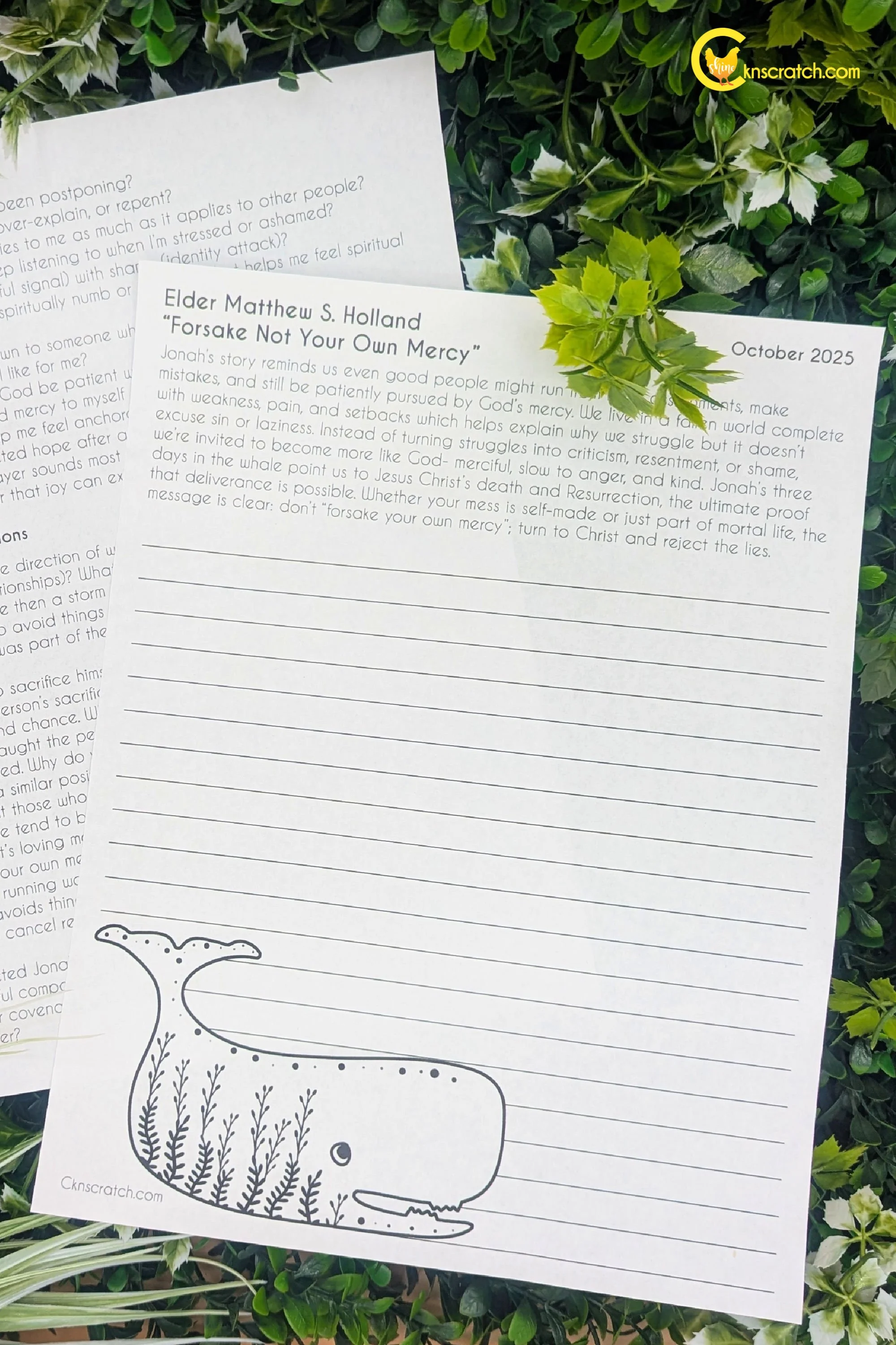
Now for some questions to help you ponder and get more out of this great talk. We’ve also included in these in the free printable found toward the end of the post. Use the study sheet to write down some of your answers to these questions.
What nudges from God have I been postponing?
When I mess up, do I run, hide, over-explain, or repent?
Do I believe God’s mercy applies to me as much as it applies to other people?
What is one “lying vanity” I keep listening to when I’m stressed or ashamed?
Where do I confuse guilt (useful signal) with shame (identity attack)?
What patterns make me feel spiritually numb or distant? What helps me feel spiritual alive and close?
Do I resent mercy being shown to someone who hurt me? Why?
What does repentance feel like for me?
What is one way I’ve seen God be patient with me like He was with Jonah?
Where do I need to extend mercy to myself without excusing wrong choices?
How do my covenants help me feel anchored when life gets chaotic?
When have I felt unexpected hope after a hard season?
What part of Jonah’s prayer sounds most like my life right now?
What helps me remember that joy can exist even when circumstances aren’t ideal?
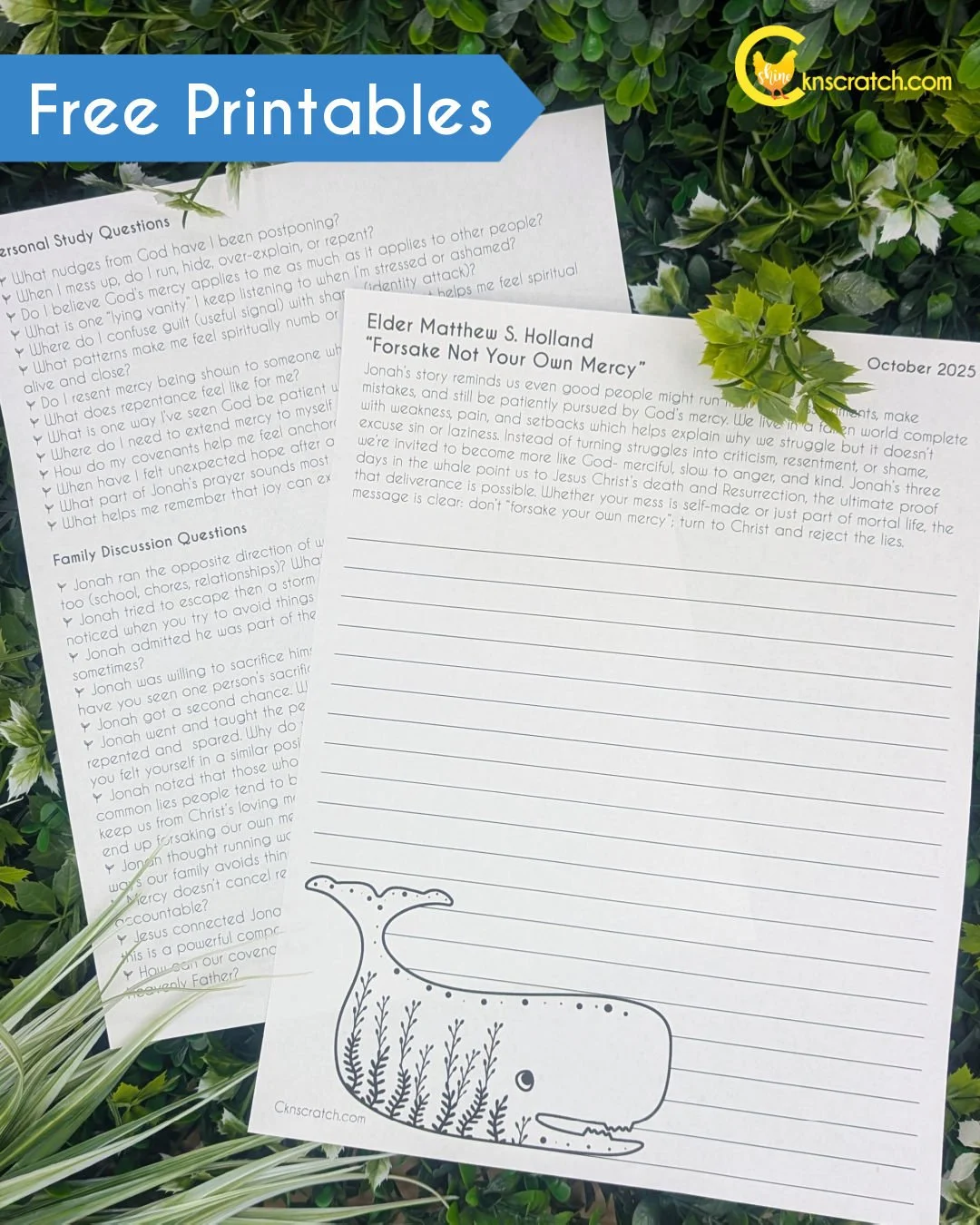
Discuss it at as Family
This talk goes wonderfully with your study of the book of Jonah (November 23-29) as well as when we talk about the Fall in this year’s Come Follow Me studies (January 19-25). Of course, you can study it any time too. Here are some questions that can come in handy as you study with your family:
Jonah ran in the opposite direction of what God asked. When do we sometimes do that too (school, chores, relationships)? What can help us do the hard, scary thing anyway?
When Jonah tried to run away, a storm came. What are some warnings signs you have noticed when you try to avoid things that God has asked you to do?
Jonah admitted he was part of the problem. Why is owning our choices so hard sometimes? How can we become better and owning our mistakes?
Jonah was willing to sacrifice himself in order to save the others on the ship. When have you seen someone sacrifice to help a whole group?
Jonah got a second chance. What’s a time you were grateful for a do-over?
Jonah went and taught the people of Nineveh but was mad when his enemies repented and were spared. Why do you think he was frustrated instead of joyful? When have you felt yourself in a similar position? What did you do about it?
Jonah noted that those who believe lying vanities forsake their own mercy. What are common lies people tend to believe about God or themselves today? How do those lies keep us from Christ’s loving mercy? What truths should we strive to remember so we don’t end up forsaking our own mercy too?
Jonah thought running would be the answer. What are some ways our family avoids things? How can we do better?
Jesus connected Jonah’s three days in the whale to His Resurrection. Why do you feel this is a powerful comparison?
How can our covenants with God be anchors for us on our path home to our Heavenly Father?
Teach it at Church
Jonah’s story makes a great framework for your church lesson. Let the class discuss why we run, how we come back, and what mercy looks like even when it’s offered to someone we don’t think deserves it. Here are few questions to help you get the discussion going. These are also included in the free printable.
What does Jonah’s flight teach about reluctance, fear, and prejudice in discipleship?
How does Jonah’s story show both justice and mercy in God’s character?
In what ways does your testimony of the Fall enable you to have charity?
How do we teach accountability while still teaching compassion for human weakness?
What “lying vanities” are most believable to you personally? How do you recognize them? In what way do they convince you to forsake your own mercy?
Where do we see God’s patience with Jonah mirrored in our own lives or elsewhere in the scriptures?
What’s the difference between regret that leads to repentance and despair that leads to hiding?
How does service and thanksgiving function as spiritual medicine in your life?
How do we reconcile God’s mercy for enemies with our desire for fairness?
If you taught this talk to youth, what one invitation would you emphasize and why?
Think of a time you felt like Jonah- either running from a responsibility or resisting what God asked. What helped you notice you were heading to Tarshish and you needed to stop?
Jonah didn’t just struggle with fear; he struggled with who God was sending him to. When have you had a hard time offering grace to someone you didn’t think deserved it? What helped you?
Where do you see the difference between consequences and condemnation in Jonah’s story and how does that difference show up in your life?
Elder Holland suggests a testimony of the Fall can soften our reactions to weakness. How has understanding mortality changed the way you judge yourself?
Want more General Conference study helps?
If you’re studying October 2025 General Conference talks, head to our October 2025 Conference Study Helps collection for more talk summaries, note pages, and discussion printables you can use at home and at church.




Your Conference and Come Follow Me playlist from October to December 2026.