
Ideas to Teach "How Can I Be Clean and Happy Again After I Sin?"
This post may contain affiliate links which means I may be paid for products you purchase through my links. See my full disclosure for more.
Come gather some teaching ideas for the Latter-day Saint youth Come Follow Me lesson, “How Can I Be Clean and Happy Again After I Sin?”. This lesson is scheduled to be taught on September 11, 2022, but makes a great lesson any time of the year. As you teach, remember to point it all back to Jesus Christ, our Savior, and emphasize the joy that is possible because of our Redeemer’s atoning sacrifice for us. Keep reading for six great ideas to help you teach about repentance.
Save it for later, pin it now!

Listen or Watch
Word Association
Try opening it with a word association game where you say a word and your class writes down the first thing they think of when they hear it. This is a great way to see how people feel about repentance in general. Bury the word “repentance” at like number seven out of ten words so by that point your class is going with the flow and doesn’t overthink it. Try it out with me. I'm going to list the ten words, you write down the first word you think of after reading it:
Prayer
Faith
Gospel
Jell-o
Potluck
Depending on which class you are in, Young Men’s or Young Women's
Repentance
Chocolate
Church
Christmas
How’d it go? After everyone writes their answers on a piece of paper, gather and mix them all up so no one can tell who’s is who’s. Read the answers for “repentance” out loud. If the overall response is positive, that’s fantastic! Roll with it and ask your class why they wrote the words they did. Why is repentance a joyful thing?
If the overall response is negative or neutral, read this quote from President Russell M. Nelson while holding up a picture of Jesus with His arm outstretched:
“Too many people consider repentance as punishment—something to be avoided except in the most serious circumstances. But this feeling of being penalized is engendered by Satan. He tries to block us from looking to Jesus Christ, who stands with open arms, hoping and willing to heal, forgive, cleanse, strengthen, purify, and sanctify us.”
Remember it's Satan that doesn't want us to repent. Jesus Christ is opening his arms towards us, welcoming us in, helping us along the way through that repentance process.

Disappearing Sins Experiment
If you like object lessons, then you're going to want to try my Disappearing Sins Experiment. Print off my baptism picture with the word “sins” above it, put it in a ziplock bag, get all the air out of it, fold it over, tape it down, then get a black Sharpie. Trace the baptismal picture onto the bag- the thing we want to keep showing. Then grab a tall glass vase filled with water to immerse your bag in. As it enters the water, the word “sins” disappears and you can only see the person being baptized. Read more about how to perform the experiment and print the image.
Try it at home first so you understand how it works. When you do the experiment in class, remember to invite them to stand up and gather around as you do it. Then read Isaiah 1:16-18 about our sins being as scarlet then becoming as white as snow and discuss.
Stopping vs. Repenting; Godly Sorrow vs. Worldly Sorrow
Ask your class what the difference is between stopping the sin and actually repenting. Is there a difference? What really is repentance? We can stop doing something and not actually repent for it. What does that look like? How is that different? Why should we still be repenting?
Another great discussion point is the difference between worldly sorrow and godly sorrow. There's a big difference and we want to have godly sorrow, not worldly sorrow. In 2 Corinthians 7:9-10, it talks a little bit about it. Some of the things that happen because of worldly sorrow are we have self-loathing which leads to shame, which leads to hopelessness, which leads to despair. That's not where we want to be. But that's where a lot of people end up going, especially when they feel they are the only ones that do it, or they keep sinning the same way over and over again. It happens! We're imperfect people. That doesn't mean that you need to have hopelessness and despair.
Part of the repentance process is actually having godly sorrow. That's when we realize what we've done is wrong, it's disappointed Heavenly Father and Jesus Christ, and that we actually need to repent. Godly sorrow leads to regret then change and hope, forgiveness, and ultimately peace. Huge difference there.
You can see how God wants us to have that peace and forgiveness and hope rather than despair. Try taking all those words and put them on strips of paper. Place all the strips on the ground and ask your class to arrange them in a way that would be like a repentance process without them realizing that it's two different things. Hopefully, they figure it out as you go but if not, you can help them. Show your class Satan’s counterfeit for repentance. A lot of us get trapped in worldly sorrow sometimes so it's good to realize that isn’t the path we want to be on. Shame is not part of Heavenly Father's process.
What stops us from repenting
There are some great articles about repentance in the church magazines. I came across two that I really liked:
Print off those two articles and cut them up so you have all the titles (fears and myths) separated from the explanations and quotes. Then you can do a matching activity or pass out a fear/myth to different groups and have them come up with how we can overcome that difficulty and why repentance is worth the effort. There are some great quotes included in those articles that you may want to read as well.
I guarantee you and those in your class have felt or thought at least one of these things before. It’s great to go over them, know we aren’t alone in those thoughts and remember the joy that comes after repentance is absolutely worth it.
One of these things isn’t like the others
Remember repentance is a process. Let’s play One of These Things Isn’t Like the Others. List these things on the board, bring in a prepared sheet of paper, or read them out loud. Invite your class to pick the one thing that doesn’t belong in the repentance process. Here’s an example, see if you can figure it out: Paying your tithing, feeling remorse, seeking forgiveness, going to church, giving service, forgiving others, confessing your sin, and having a change of heart.
Surprise! They actually all belong. Righteous living is actually part of the repentance process. After we repent and have that change of heart, we strive to live an obedient life. As we continue to live a righteous life, we gain that repentance. It's all part of it. We often don't think about paying our tithing or giving service as part of repentance but they are. Just like we talked about baptism with the Disappearing Sins Experiment, this is a great time to also talk about the sacrament and the atonement of Jesus Christ, and how we can repent every single day. Discuss the purpose of all those things and how they work together and how we can be clean and happy again.
It’s about the Change
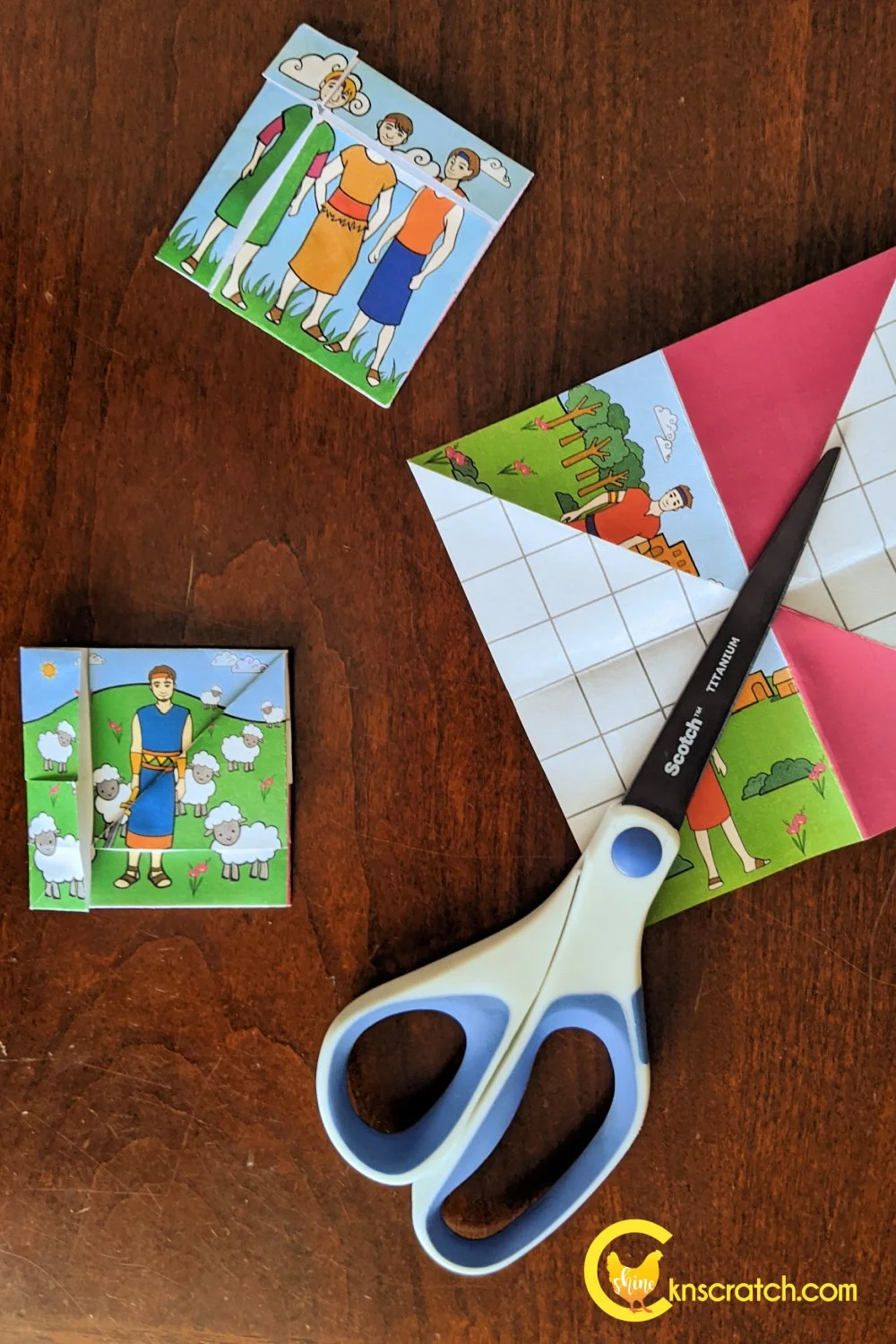
I love folding paper puzzles. It's kind of like origami, but with a puzzle. These puzzles feature scenes with Alma and the sons of Mosiah because that is an easy to point to repentance story. The goal of the puzzle is to have the scene put together all on one side, the solid color all together on the other side, and the grid lines or the white part all in the middle. It’s a great example of how change is part of the repentance process.
Hopefully, you struggle a little bit putting these together because that's part of the process too! Sometimes we have to try again and again and again, because we are imperfect beings. We even sin the same way over and over again, but we keep trying, we keep sincerely repenting and we become something new, something even better, something complete just like how we put these puzzles together.
Send the puzzles home or take time to do them in class. Discuss how we change, how it takes effort, and how it can be hard. We might mess up. We have to try again, but it's all worth it in the end.


Celebrate the sweetest story ever told, one tiny treat at a time.
Turn everyday candies into thoughtful Christmas gifts, a daily scripture countdown, or a family Christmas Eve devotional. Our Nativity Candy Circles attach to wrapped treats like Hershey’s Kisses, Rolos, and miniature Reese’s peanut butter cups, adding a reminder of Jesus Christ to each little bite.
For a countdown, include one of each picture and choose a candy at random each day, December 1–24. Match the picture to the scripture guide and read about the Savior’s birth, life, and mission. For a Christmas devotional, use the separate numbered Nativity guide to assign readings and share the Christmas story together.
Or simply fill a mug, jar, treat bag, or stocking with decorated candies. No counting required! Add a matching gift tag for neighbors, teachers, friends, or the families you minister to.
Your instant-download PDF includes:
Two sets of 24 candy-circle designs: a KJV Bible edition and a Bible + Book of Mormon edition, with four complete sets per candy-circle page.
Matching scripture countdown guides for both editions, with picture references, short reading titles, and checkboxes.
Nativity devotional reading guides for both editions, with numbered assignments for reading the Christmas story in order.
Coordinating gift tags and jar-lid labels.
Assembly instructions and creative gifting ideas.
Print the candy circles at actual size, cut with scissors or a ¾-inch circle punch, and attach them to your wrapped candies with a glue stick or double-sided tape.
This is a digital download. Candy, containers, and assembly supplies are not included.