Fact or Fiction? A Free Printable Fact-Checking Game
This post may contain affiliate links which means we may be paid for products you purchase through our links. See our full disclosure for more.
How sure are you that goldfish only remember things for three seconds? What about the Great Wall of China being visible from the Moon? Or water always boiling at 212°F?
You may know the answer. You may think you know the answer. Or you may have heard something so many times that you stopped wondering whether it was actually true. Fact or Fiction is a free printable fact-checking game that puts all of that to the test.
Save this idea for later, pin it now.
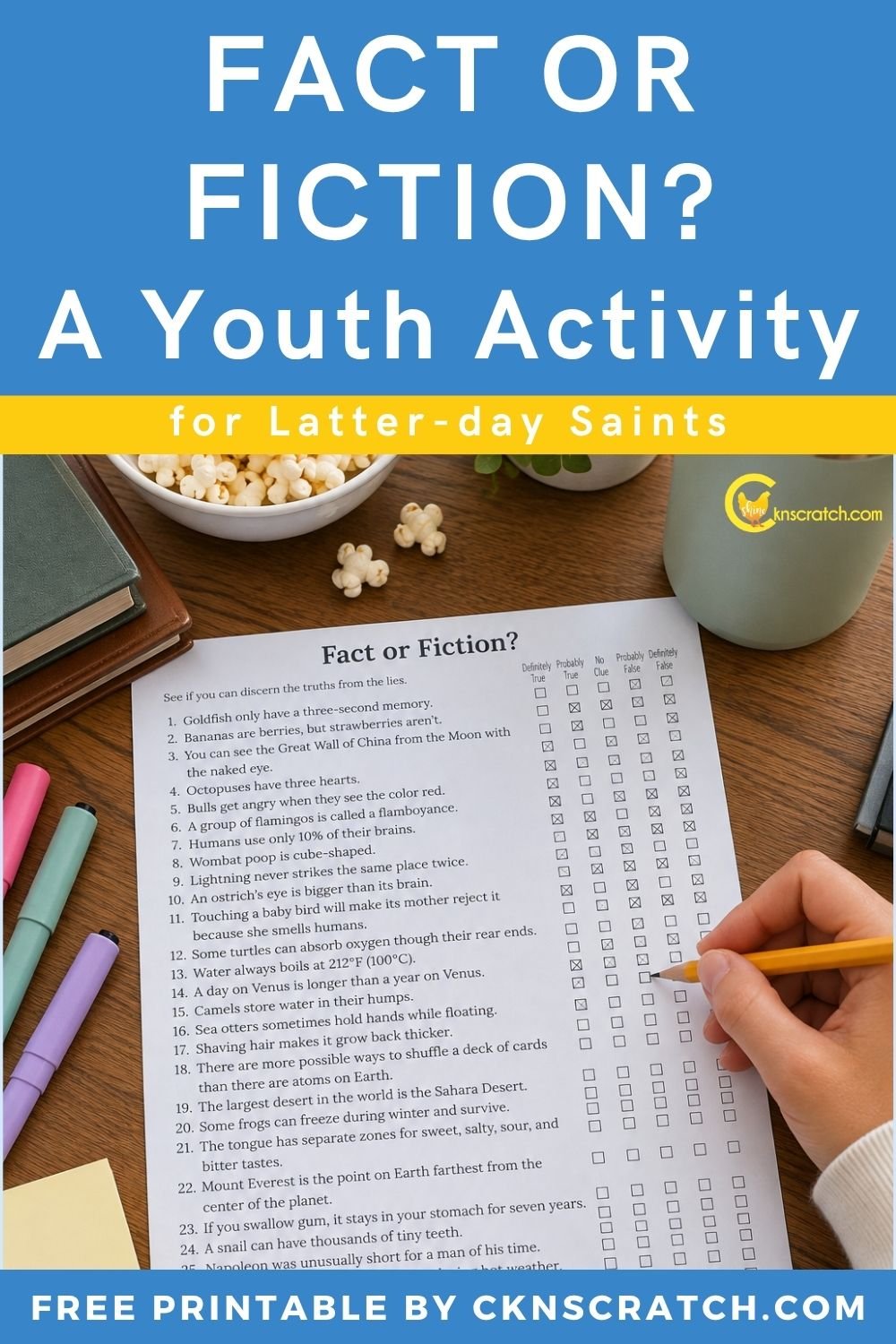
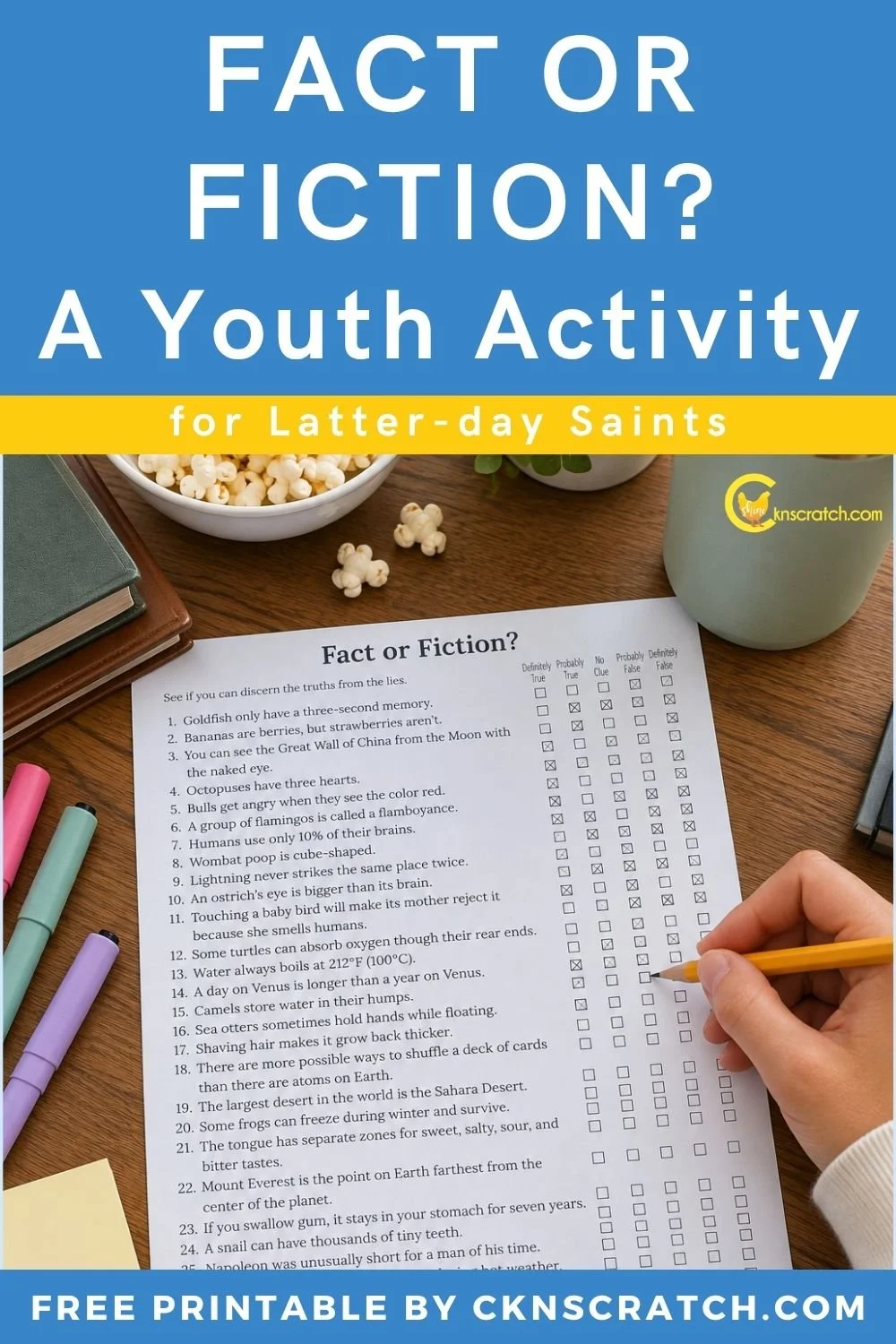
Instead of simply choosing true or false, players also decide how confident they are in their answer. Then comes the important part: finding out what is actually true and looking at the evidence behind it.
It makes a fun activity for youth groups, families, classrooms, homeschool groups, Relief Society activities, or anyone who enjoys discovering that wombat poop is somehow relevant to an evening of learning.
How to Play Fact or Fiction
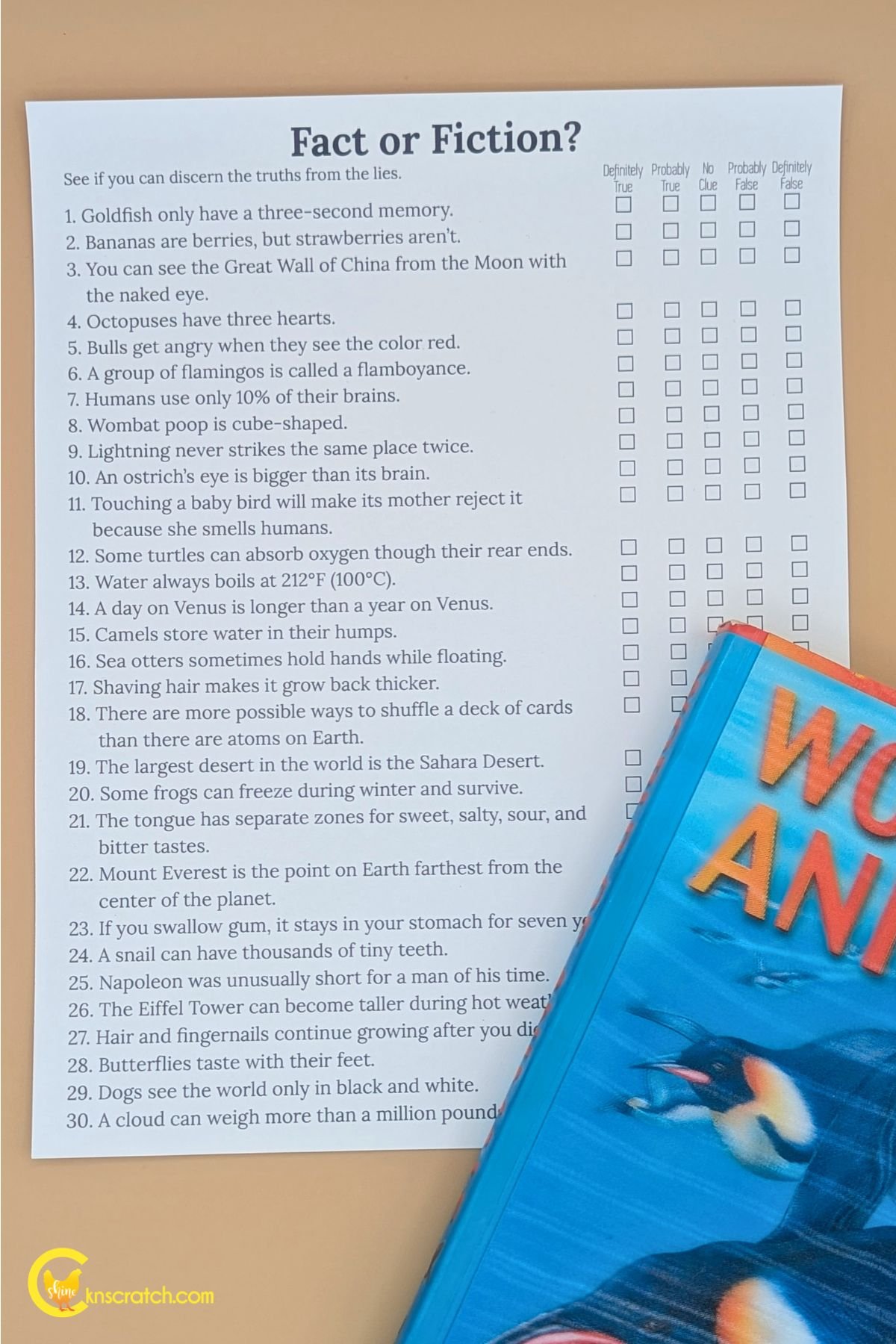
Print our free Fact or Fiction Challenge. It includes 30 statements covering science, history, nature, everyday myths, and plenty of strange facts that sound completely made up.
For each statement, players choose one answer:
Definitely True
Probably True
No Clue
Probably False
Definitely False
Invite everyone to complete the challenge individually, work in pairs, or divide into small teams. Don't reveal the answers as you go. We want everyone to commit to what they think first.
Once everyone has finished, start checking the answers. And yes, there will probably be some very confident wrong answers. That's half the fun.
You can also turn Fact or Fiction into a move-around-the-room game. Hang signs for Definitely True, Probably True, Probably False, and Definitely False in four different areas of the room. Read one statement at a time and have everyone move to the answer that best matches what they believe. Once everyone has chosen a spot, let them defend their answers before revealing the truth or sending them to a trusted source to fact check it.
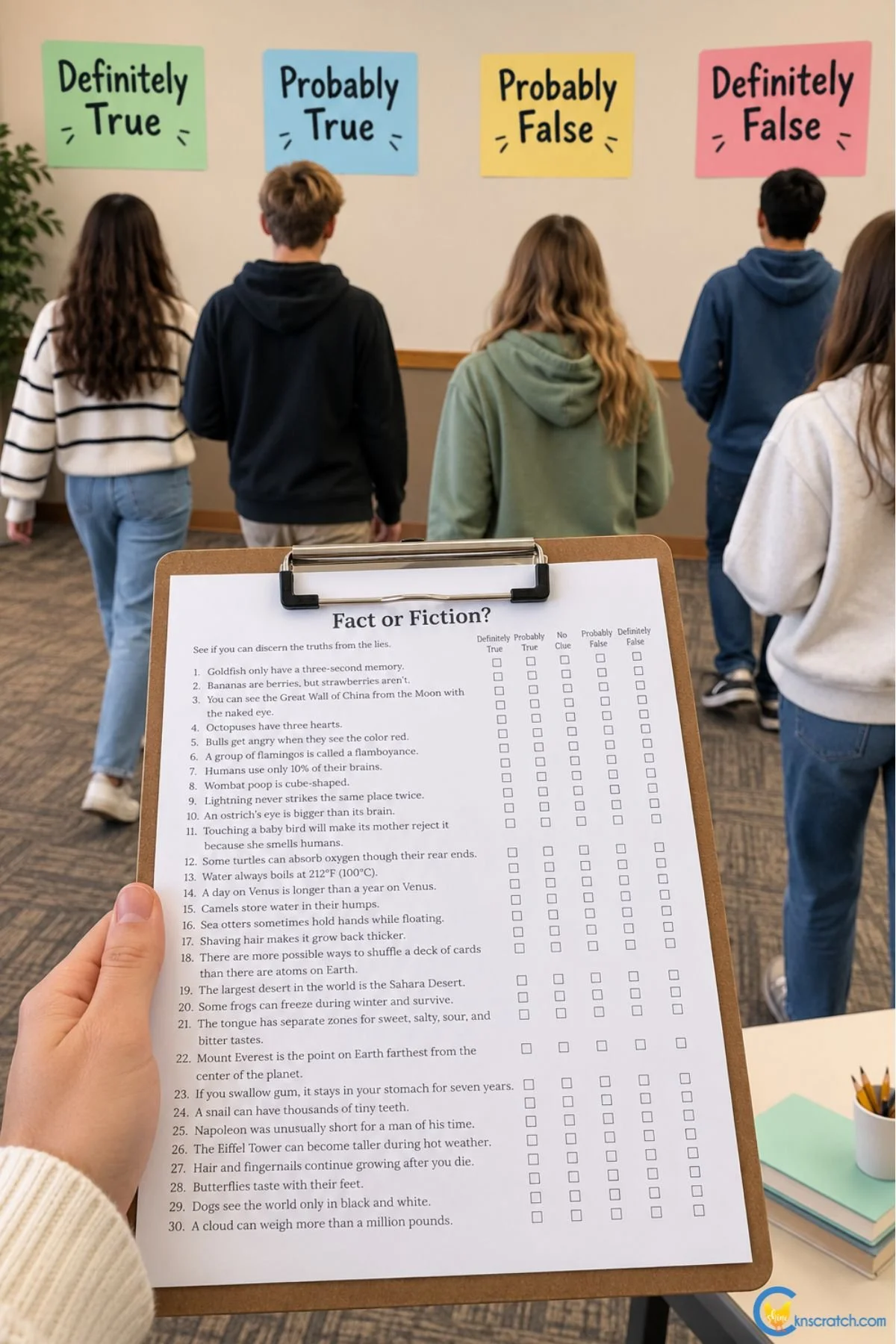
This is an AI example using our free handout.
Don't Just Give Them the Answers
Here's what makes Fact or Fiction different from an ordinary trivia game.
Before revealing every answer, choose several of the statements and let players fact check them themselves.
Give them access to phones, tablets, computers, books, or other available resources. Their job isn't simply to find a website that agrees with them. They need to find a source they have good reason to trust.
Ask questions such as:
Who published this information?
Where did they get their information?
Is this an organization or person who would know about this subject?
Can you find another reliable source that says the same thing?
Is the information current?
They can even ask an AI tool for help. Just don't let the AI response be the final source. AI can be useful for finding information and figuring out what questions to ask, but it can also give incorrect information with impressive confidence.
Make It a Competition
You don't need to keep score, but you certainly can.
Give one point for every correct answer. For an extra challenge, award a bonus point when someone chooses Definitely True or Definitely False and gets the answer right.
Or forget points altogether and look for the more interesting victories:
Who had the most confident wrong answer?
Which fact fooled almost everybody?
Which answer caused the biggest argument?
Which fact sounded completely ridiculous but turned out to be true?
And which "fact" had everyone saying, I've believed that my entire life!
Those conversations are often more memorable than finding out who won.
For Strength of Youth Tie-In: Truth Will Make You Free
This activity works especially well when youth are studying “Truth Will Make You Free” in For the Strength of Youth: A Guide for Making Choices.
The fun facts aren't meant to turn the activity into a gospel trivia lesson. Instead, they give youth a chance to practice something important: not everything we hear is true, even when it sounds convincing or we've heard it repeated over and over. Finding real answers means looking beyond the claim and turning to sources we can trust.
We hear information from friends, teachers, videos, social media, AI, family members, and plenty of other places. Rather than simply accepting what we hear, we can ask questions, consider the source, and seek reliable information.
That same principle matters when we're searching for gospel truth. Heavenly Father has given us trustworthy ways to seek answers, including the scriptures, living prophets, the Holy Ghost, and sincere prayer. President Dallin H. Oaks teaches more about choosing the right sources in his General Conference talk “Truth and the Plan” (October 2018).
You don't need a long discussion after the game. Ask youth which answers surprised them, what made them trust certain claims, and how they decided which sources were reliable. Then connect their experience to the invitation to seek and love truth.
Fact Check Our Fact Checking
Part of seeking truth is learning to check the source, so we don't expect you to simply take our word for these facts either!
Below you'll find the sources we used to verify each statement. Whenever possible, we looked for reliable sources such as NASA, the National Weather Service, Smithsonian, Mayo Clinic, universities, museums, and government agencies.
The printable includes an answer key with the correct answers and a short explanation for each one. If you'd like to dig deeper, check our work, or settle a particularly passionate debate about goldfish, we've gathered the sources we used below.
Goldfish Memory: Live Science
Bananas & Strawberries: Live Science
The Great Wall of China: NASA
Octopus Anatomy: Live Science
Bulls & the Color Red: University of Navarra Science Museum
Flamingos: Smithsonian's National Zoo
The 10% Brain Myth: MIT McGovern Institute
Wombats: Science.org
Lightning Myths: National Weather Service
Ostrich Anatomy: Smithsonian's National Zoo
Baby Birds & Human Touch: Audubon
Turtle Respiration: McGill University Office for Science and Society
Boiling Water & Atmospheric Pressure: National Institute of Standards and Technology
A Day and Year on Venus: NASA
Camel Humps: Cleveland Zoological Society
Sea Otter Behavior: Seattle Aquarium
Shaving & Hair Growth: Mayo Clinic
Shuffling a Deck of Cards: McGill University Office for Science and Society
The World's Largest Desert: National Geographic Society
Freeze-Tolerant Frogs: National Park Service
The Tongue Map: Harvard Health Publishing
Mount Everest: National Ocean Service
Swallowed Gum: Mayo Clinic
Snail Teeth: Natural History Museum of Los Angeles County
Napoleon's Height: History.com
The Eiffel Tower & Heat: Official Eiffel Tower Website
Hair and Fingernails After Death: University of Arkansas for Medical Sciences
How Butterflies Taste: American Museum of Natural History
Dog Color Vision: American Kennel Club
How Much a Cloud Weighs: U.S. Geological Survey
Don't stop here if you're still curious. Compare sources, look for additional evidence, and see what else you can learn. Finding one webpage that agrees with you isn't the same thing as finding a trustworthy answer.

Ideas to help you plan your church activities this November