
10 Church Activities for November
This post may contain affiliate links which means we may be paid for products you purchase through our links. See our full disclosure for more.
10 Church Activity Ideas for November
November activities do not all have to involve tracing a hand turkey or listing things we are grateful for on paper leaves. Gratitude certainly belongs this month, but we can help it move beyond a list and turn into noticing people, expressing thanks and offering useful service.
These November church activity ideas also include plenty of room to move, experiment, solve problems, learn practical skills and laugh together. Use them for Primary, Youth groups, or even Relief Society. November’s For the Strength of Youth study focuses on “Truth Will Make You Free,” so we are added an activity to help you reinforce that too.
Choose one idea, adapt it to the people in your group and leave out anything that creates more work than value. A worthwhile church activity does not need an elaborate theme or a supply closet that looks like Hobby Lobby moved in, it simply needs to help people come closer to Christ.
Save it and use it later, pin it now
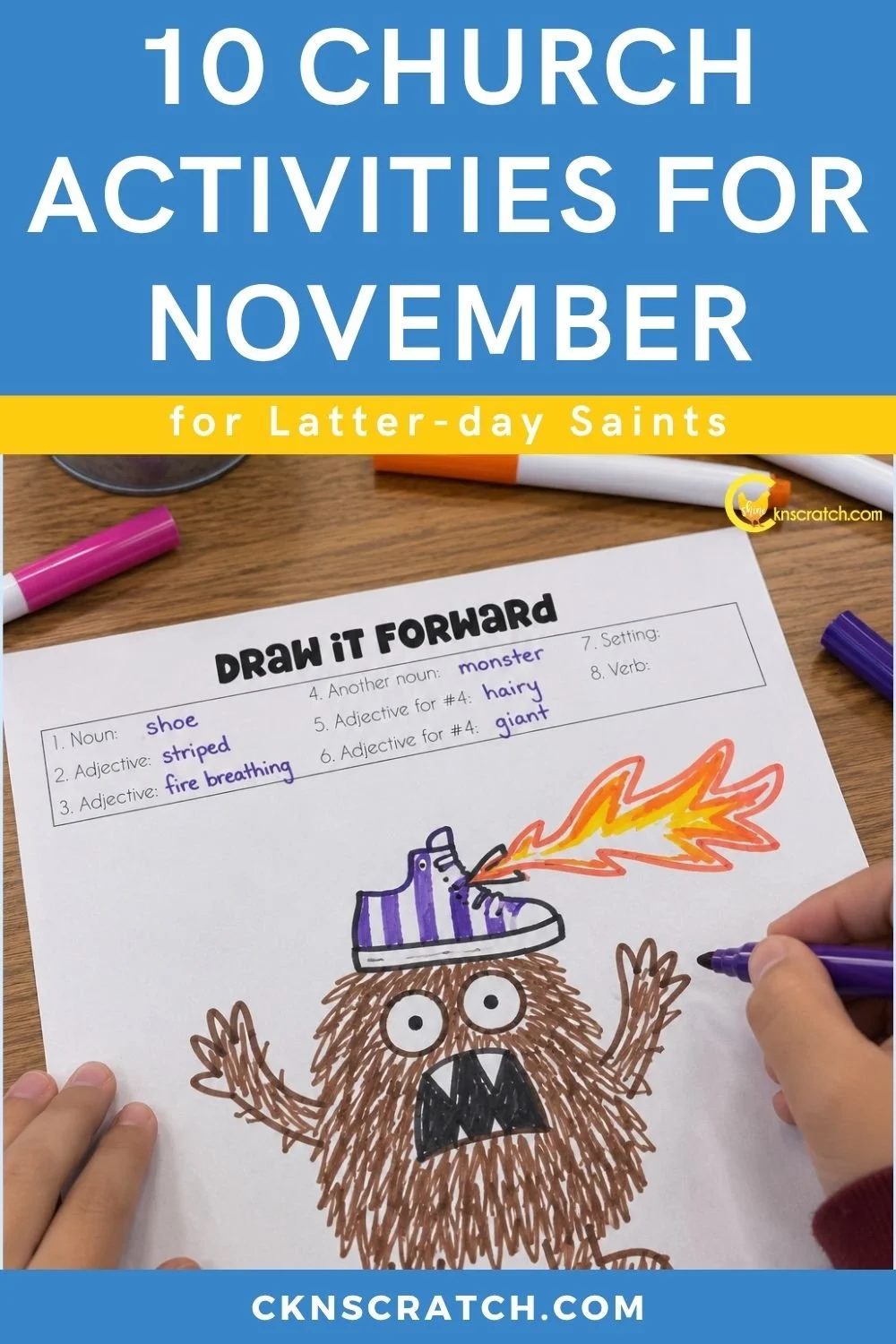
This is an AI example using our free handout for idea #6
1) Fact or Fiction Challenge
Growth Areas: Intellectual, Spiritual
How sure are you that goldfish only remember things for three seconds? What about the Great Wall of China being visible from the Moon? Our free Fact or Fiction Challenge gives you 30 strange facts and familiar myths to put everyone to the test.
Instead of simply choosing true or false, players choose Definitely True, Probably True, No Clue, Probably False, or Definitely False. Once everyone has committed to their answers, don't immediately pull out the answer key. Choose a few statements and let everyone fact check them using phones, books, or other available resources. Can they find a reliable source? Who published the information? Is it current? Can another trustworthy source back it up?
You can also turn it into a move-around-the-room game. Hang Definitely True, Probably True, Probably False, and Definitely False signs in four areas of the room. Read each statement aloud and have everyone move to the answer they believe. Give them a chance to defend their choices before checking the facts.
GOSPEL TIE-IN: Heavenly Father expects us to seek truth, not simply believe the loudest or most confident voice. Discuss the sources we can trust when we have spiritual questions, including the scriptures, living prophets, prayer and the guidance of the Holy Ghost. We can also practice patience when an answer does not come immediately.
FSY TIE-IN: Connect the activity to the November For the Strength of Youth study of “Truth Will Make You Free.” Ask how checking the source of an online claim compares with seeking reliable answers to gospel questions. What helps us recognize truth, and what should we do when something we hear does not match what God has taught?
2) Thanksgiving Food Lab
Growth Areas: Intellectual, Social
Put on the imaginary lab coats. We're experimenting with Thanksgiving dinner.
Divide everyone into small groups and give each one a simple food question to test. Keep the experiments inexpensive, choose ones that can be completed during your activity, and foods your group is actually interested in. Try questions like:
Does milk, cream, or broth make the best mashed potatoes?
Can you tell name-brand foods from store-brand foods in a blind taste test?
Which method keeps cut fruit from browning the longest?
Does chilling cookie dough actually change the finished cookie?
Can people identify different flavors when they can't see what they're eating?
Does the shape or size of a potato change how quickly it cooks?
Before testing anything, have each group make a prediction. Then let them conduct their experiment, record what happened, and present their results to everyone else.
You don't need ten different recipes or a kitchen full of ingredients. Two or three experiments with several groups testing the same question can be even more interesting. Compare everyone's results at the end and see if you can come to the same conclusion.
For younger Primary children, simplify it to predictions and taste tests.
GOSPEL TIE-IN: Learning often begins with a question, followed by careful observation, effort and a willingness to adjust our thinking. The same pattern can strengthen our testimonies. We can ask sincere questions, study, act on what we learn and notice the results over time. As taught in Doctrine and Covenants 88:118, we seek learning “by study and also by faith.”
3) Thank-a-Thon
Growth Areas: Social, Spiritual
How many people can your group genuinely thank in one night?
Before the activity (or at the beginning), make a list of people who help your youth, ward, schools and community but may not hear “thank you” very often. Consider seminary teachers, school custodians, Primary teachers, coaches, librarians, crossing guards, bus drivers, church leaders, the person who makes the ward bulletins or emails, building cleaners, school secretaries, activity helpers, and neighbors.
Divide everyone into teams and assign several people or groups to each one. Their job is to create a specific thank-you rather than writing “Thanks for all you do!” forty times. You may need to teach them how to do this.
They might write individual notes describing something they have personally noticed, decorate a large thank-you poster for an entire staff, record a short group video, assemble a basket of handwritten notes or pair one of our printable gift tags with an inexpensive treat.
Spend most of the activity creating the thank-you notes. Allow time at the end to deliver anything that can reasonably be delivered that evening. If the recipients are not nearby, assign someone to deliver each item during the week.
The gifts do not need to be elaborate. We just want each recipient to know that someone noticed what they did and appreciated it. You can use our fall thank you give idea and free printable tags or try our popcorn popping bag idea for something easy.
GOSPEL TIE-IN: Jesus Christ noticed and served individuals, including people others overlooked. Talk about the difference between feeling generally grateful and expressing that gratitude to a real person. Invite everyone to look for people whose quiet efforts bless their lives and follow the counsel to “live in thanksgiving daily” from Alma 34:38.
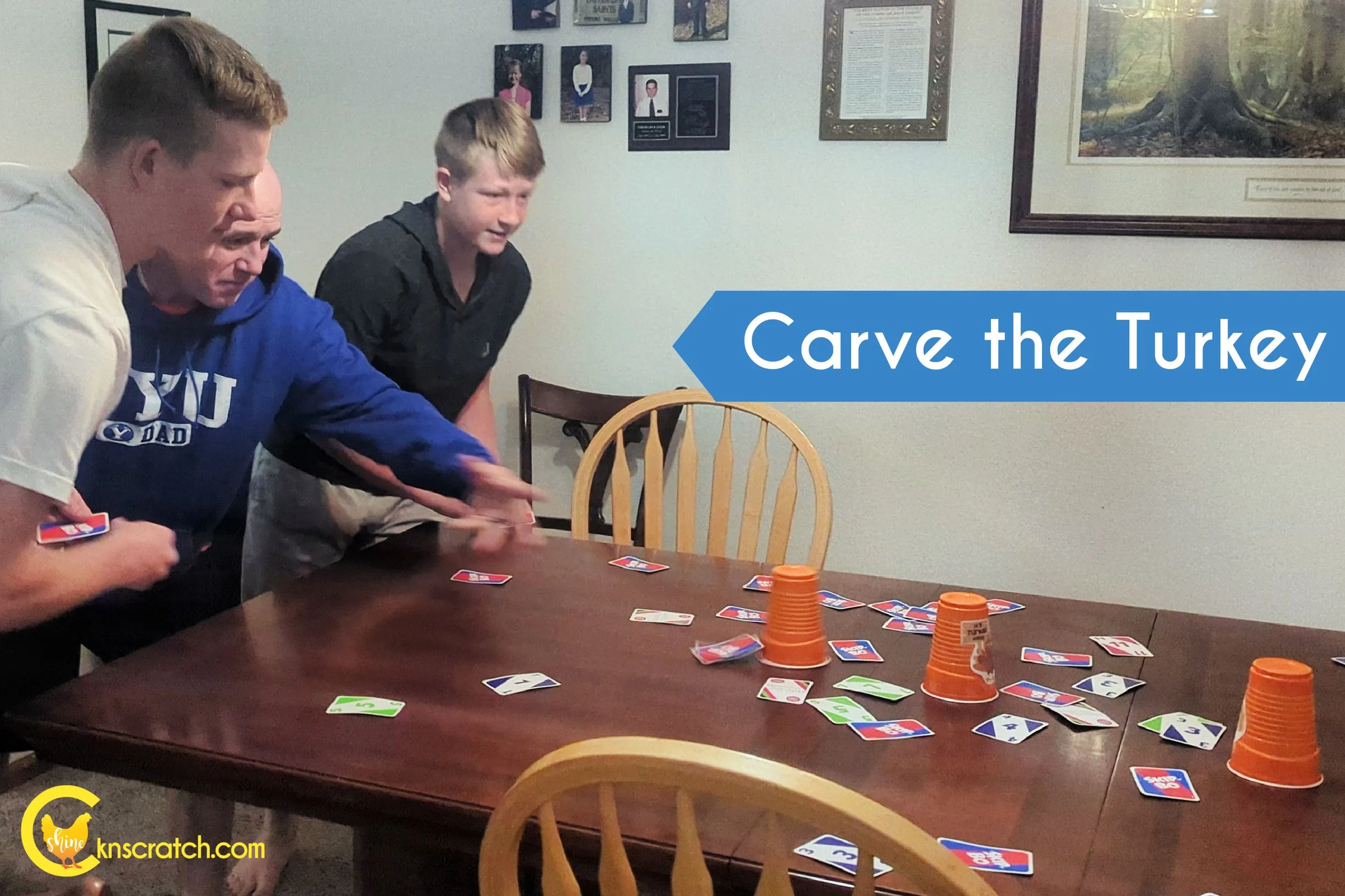
4) Thanksgiving Game Night
Growth Areas: Physical, Social
Pull out the potatoes, paper footballs, cups, spoons and a few other ordinary supplies for a Thanksgiving game night that requires very little prep.
We've already tested a whole collection of quick Thanksgiving games that work well for families and groups. Set up several around the cultural hall and rotate small groups through them, or choose three or four favorites and turn them into a tournament.
Try Carve the Turkey, Goalpost Squeeze, Turkey Shoot Out, Harvest Handful, or Potato Jousting.
Choose the games that work best for your ages, space, and group size. You'll find the supply lists, complete directions, free turkey printable, and even more games here:
GOSPEL TIE-IN: Wholesome recreation helps us build friendships and strengthen our sense of belonging. Encourage everyone to notice whether they are helping others participate, cheering for people outside their usual circle and caring more about the people than the score. Joy grows when everyone has a place in the group.
5) Repair Café: Fix It, Don't Toss It
Growth Areas: Intellectual, Social, Spiritual
Turn your activity space into a small repair café and invite ward members or neighbors to bring an everyday item that needs a simple fix.
Before this activity, you may want to spend another activity where a few adults can teach practical repairs, such as sewing on buttons, mending small tears, tightening loose parts, patching a bicycle tire or replacing a jewelry clasp. Combine those new skills with what they already know and it should be a great night.
Ask guests to describe their item when they sign up so your helpers can decide which repairs they can reasonably handle and what supplies to bring.
Set up tables by type of repair. Give youth jobs at each one: welcoming guests, sorting supplies, working alongside other skilled helpers, learning the repair, and cleaning up afterward. Sometimes they are the one that fixes it and sometimes they can learn how to fix it with someone else guiding them.
Keep the projects small enough to finish during the activity. If a guest brings something that needs parts or expertise you do not have, you can still help them identify the next step. A loose button and a broken washing machine belong in very different cafés.
GOSPEL TIE-IN: We can serve people with practical skills as well as kind words. Discuss how learning to mend, maintain and care for what we have helps us be wise stewards. When we share those skills, a small repair can also become a meaningful way to love our neighbors.
6) Draw It Forward Game
Growth Areas: Intellectual, Social
Give everyone a sheet of paper and a colored pencil or marker. For a larger group, divide into circles of about five to eight people so papers can move quickly. Everyone writes a noun at the top of their own page and draws it in the center. A penguin, bicycle, dragon or sandwich will do nicely.
Set a short timer for each turn. Everyone passes their paper to the right, writes the next addition at the top of the page and changes the drawing to show it:
Noun: Write and draw the first thing.
Adjective: Describe the first noun and draw the change.
Adjective: Add another detail to the first noun.
Second noun: Add another thing to the picture. It can be an object, animal or person.
Adjective: Describe the second noun and draw the change.
Adjective: Add another detail to the second noun.
Setting: Draw where it’s all happening.
Verb: Show something happening in the scene.
Keep passing after each turn, even if your own paper comes back to you along the way. When the eighth turn is finished, return each drawing to its original artist. Let everyone see what became of their idea and add a title if they want one. We made a sheet with all the steps listed so it’s easier to keep track as you pass.
Encourage players to use a different color from the person before them and to build on what is already drawn. For an extra challenge, prepare a stack of adjective cards and have players draw a word on turns two and six. No erasing someone else’s contribution; finding a way to make the additions work together is part of the fun.
GOSPEL TIE-IN: Every person adds something the original artist could not have made alone. Talk about how different talents and ideas can strengthen a family, class or quorum. What helped you build on another person’s contribution?
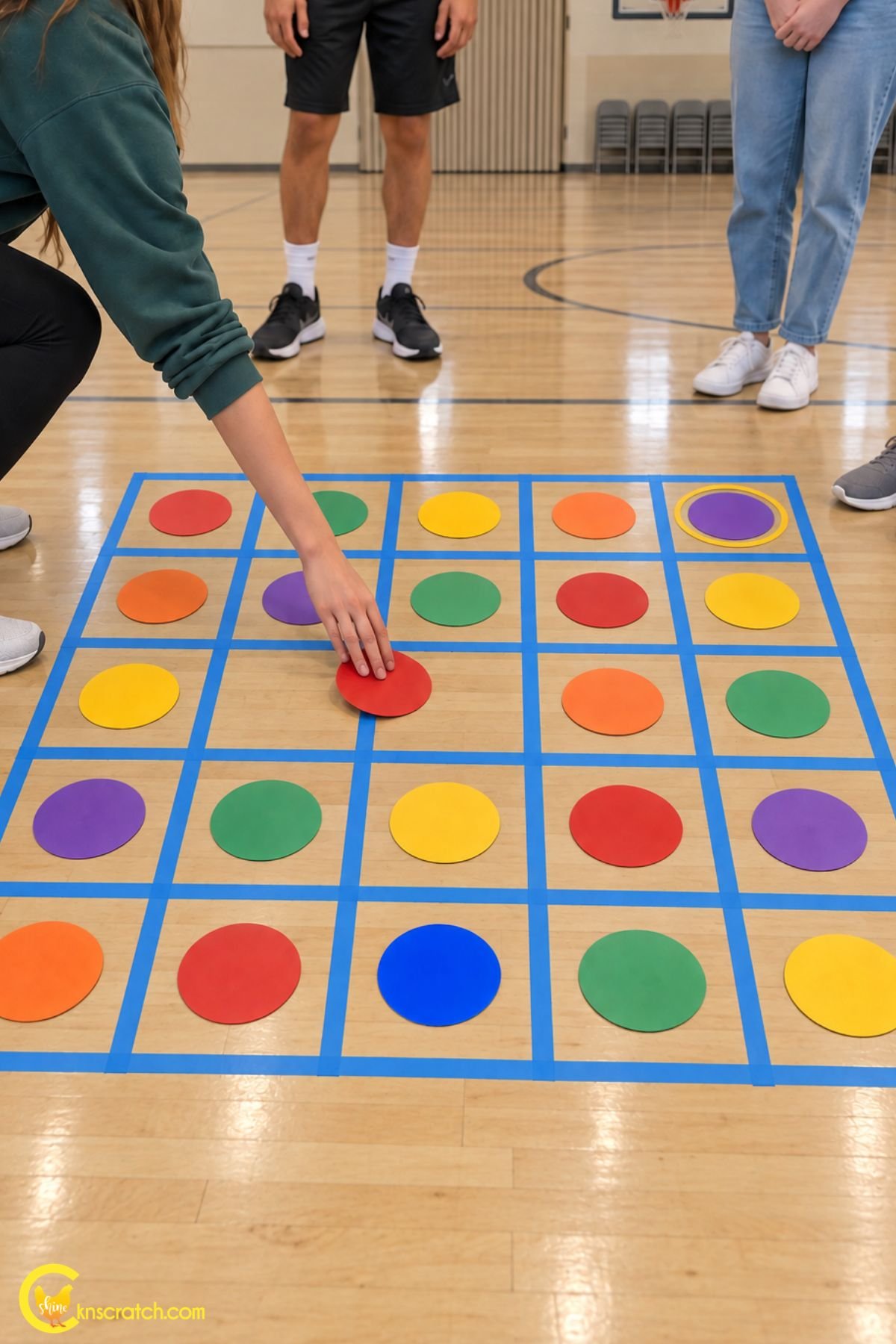
This is an AI example of The Great Team Grid Challenge.
7. The Great Team Grid Challenge
Growth Areas: Physical, Social, Intellectual
Create identical 5×5 grids for two or more teams using poster board or painter's tape. Fill each grid with colored paper circles, beanbags, cups, or paper plates, leaving one space empty. Mark one piece as the team's target and one space as the finish.
The goal sounds easy: get your target piece to the finish. The catch is that pieces can only slide into the empty space, and every round changes the rules.
Round 1: The Relay
Everyone can talk and plan. One player runs to the grid, moves one piece, runs back, and tags the next teammate. Keep going until the target reaches the finish. This round lets everyone figure out how the puzzle works and how their group works thinks before things get harder.Round 2: The Remote Control
Choose one person to be the team's Mover for the entire round. The Mover stands at the grid but cannot decide what to move and cannot talk. The rest of the team stays behind a line several feet away and has to tell the Mover exactly which piece to slide. The Mover must follow the team's instructions, even when they can see that everyone back there has made a terrible decision.For an extra challenge, don't let teams point. They have to communicate using descriptions such as “Move the yellow circle beside the blue one down.”
Round 3: Move or Mess
Bring back the relay, but now every player has a choice when it's their turn: make one legal move on their own team's grid OR make one legal move on another team's grid. Suddenly there's strategy involved. Do you keep working toward your own finish or sacrifice a turn to undo somebody else's progress?Round 4: Silent Strategy
Give teams 60 seconds to study their new grid and make a plan. When time is up, no one may talk. Players take turns making one move each, but they have to figure out what their teammates are trying to accomplish by watching the moves that came before theirs.You can make the final round harder by placing the finish farther away or changing the starting location of the target.
GOSPEL TIE-IN: The goal stays the same in every round, but the team’s ability to reach it changes depending on how well they communicate, listen, plan and trust one another. Discuss how those same skills help families, classes and quorums become more unified. As taught in Mosiah 18:21, the Lord asks His people to have their “hearts knit together in unity and in love.”
GRID
8) Thanksgiving Escape Room
Growth Areas: Intellectual, Social
Hand everyone a Thanksgiving mystery and put the clock on them.
For an easy ready-to-go option, The Great Turkey Escape on Etsy is made for tweens and teens and includes 11 printable clues and several different types of codes and puzzles. It's designed for teams of about 2–5 and takes approximately 45–60 minutes. Even better for a church activity, it doesn't require locks, internet access, or elaborate props.
With a large group, divide everyone into small teams and print a copy of the game for each team. Start everyone at the same time and see who can solve the mystery first. Leaders can serve as hint stations when groups get stuck.
GOSPEL TIE-IN: Solving the mystery requires persistence, cooperation and a willingness to look at a problem in a new way. Spiritual understanding can require those same qualities. Answers may come gradually as we study, pray, counsel together and keep working instead of giving up when the solution is not immediately obvious.
9) Teach Grandma Yor Phone
Growth Areas: Intellectual, Social
Invite older adults in the ward or neighborhood to bring their phone or tablet along with one or two things they would like to learn how to do. Maybe they want to organize photos, make the text larger, create a group text, share pictures, use maps, scan a QR code, set up emergency contacts, use FamilySearch, learn new tricks on the Gospel Library app, or finally figure out where their phone keeps putting all those downloaded files.
Pair each guest with one or two youth. Here's the important rule: the youth can't simply grab the phone and fix it. Their job is to teach.
Have the youth explain each step while the owner actually does it on their own device. Then have them write down simple step-by-step directions the person can take home and use again later.
Ask guests what they want help with when they RSVP so leaders know whether you'll need someone familiar with certain apps or devices. It's also worth reminding everyone that passwords, banking information, medical information, private messages, and other sensitive information stay private and shouldn’t be shared with anyone. They can enter their own passwords.
Finish with refreshments and time to visit. The technology gives everyone a reason to sit down together, but the conversation may end up being the best part.
GOSPEL TIE-IN: Service is not taking over and proving that we know more. Christlike service is patient, respectful and focused on what another person actually needs. Talk about how teaching someone to do something for themselves can show greater love than quickly doing it for them.
10) Build a Blessing Box
Growth Areas: Social, Spiritual
Instead of collecting a giant pile of miscellaneous donations, start with one question: Who are we trying to help, and what would actually be useful to them?
Choose several situations your ward or community regularly encounters. You could assemble hospital waiting-room bags, new-neighbor boxes, missionary care packages, chemo kits, teacher emergency kits, winter car kits, quiet sacrament-meeting bags, welcome kits for newly baptized members, foster-care support bags, or care packages for college students away from home.
Assign each small group a recipient or situation first. Before handing out supplies, give them a few minutes to decide what would genuinely help. What would someone sitting at a hospital for six hours appreciate? What does a new neighbor need that isn't just another plate of cookies? What would actually be useful to a teacher halfway through November?
Then bring out the supplies and assemble the boxes or bags. Include a personal note when appropriate and make plans to deliver them.
For a lower-cost activity, ask families to sign up ahead of time to donate specific items rather than having leaders purchase everything. You can also contact a local organization before the activity and ask what they actually need. Ten useful boxes beat forty adorable ones filled with things nobody wanted.
GOSPEL TIE-IN: King Benjamin taught that when we serve others, we are serving God. Thoughtful service begins by noticing a real person and asking what would genuinely help them. Discuss how we can follow the Savior’s example by seeing individuals rather than treating service as a project to complete.
Whichever idea you choose, keep the people at the center of the plan. Supplies can be simplified, rules can be adjusted and activities can be shortened. The goal is to create a place where people can learn, serve, connect and grow closer to Jesus Christ together.

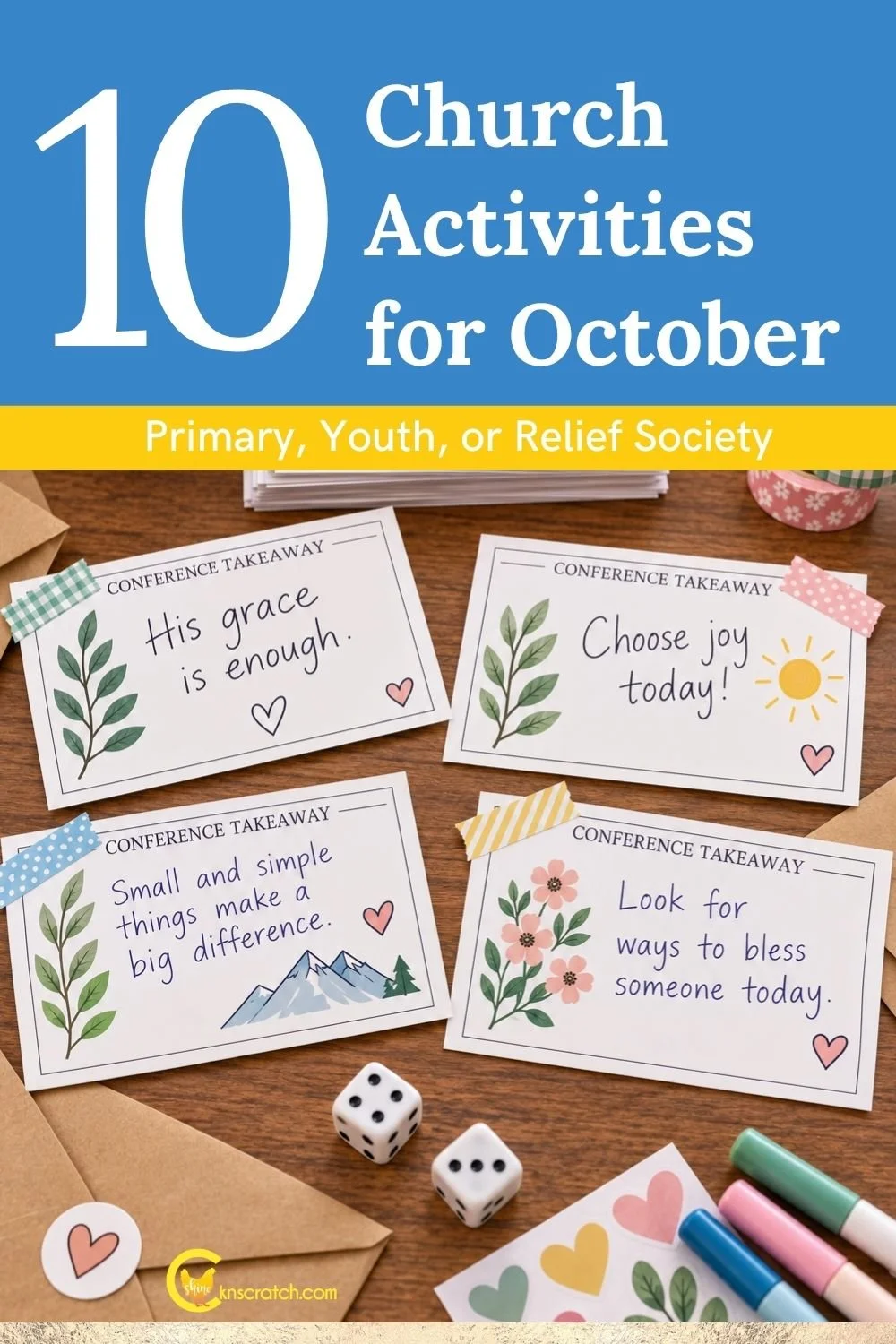

Ideas to help you plan your church activities this November