
Study Help for Brother Chad H. Webb’s “That All May Be Edified” (October 2025)
This post may contain affiliate links which means we may be paid for products you purchase through our links. See our full disclosure for more.
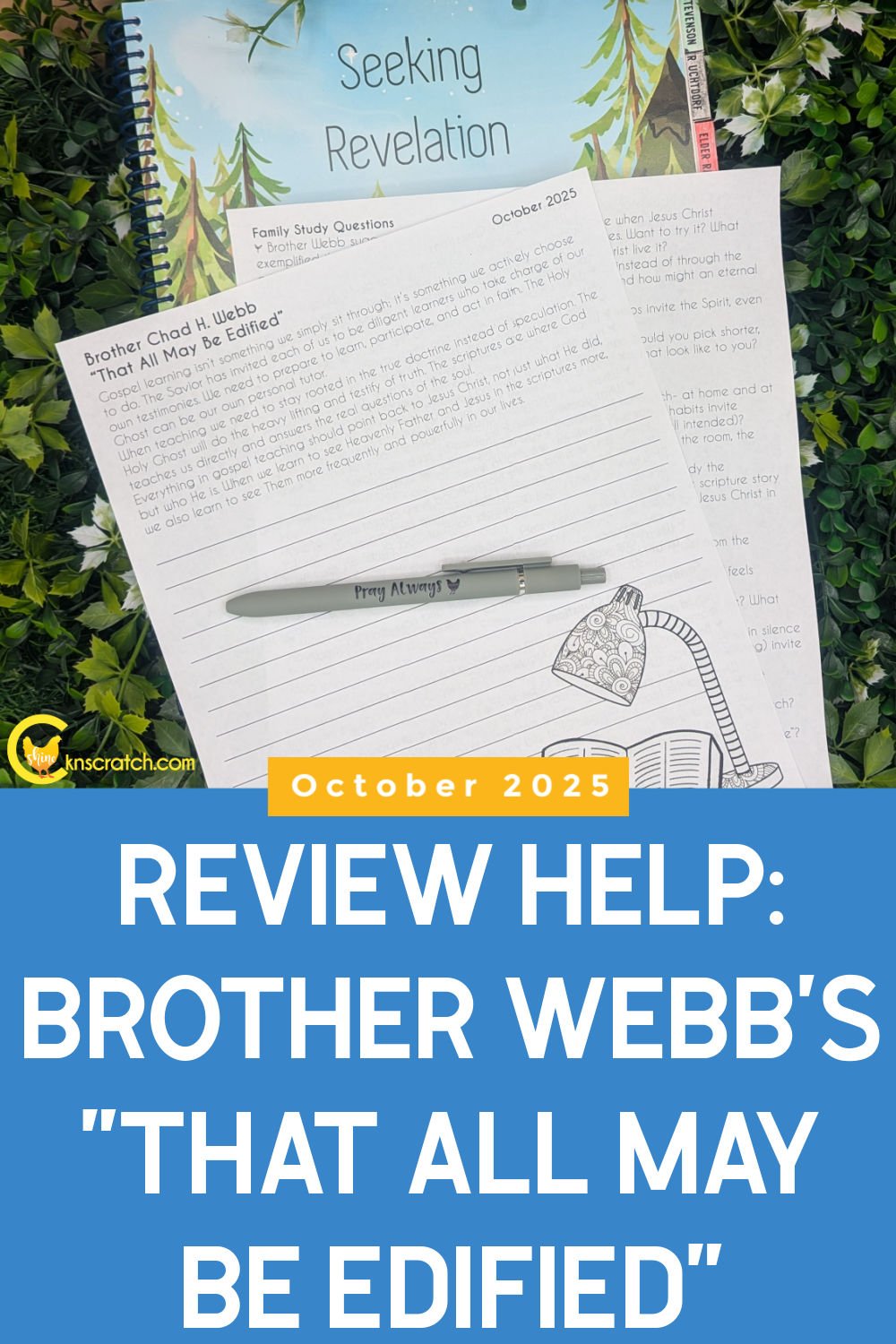
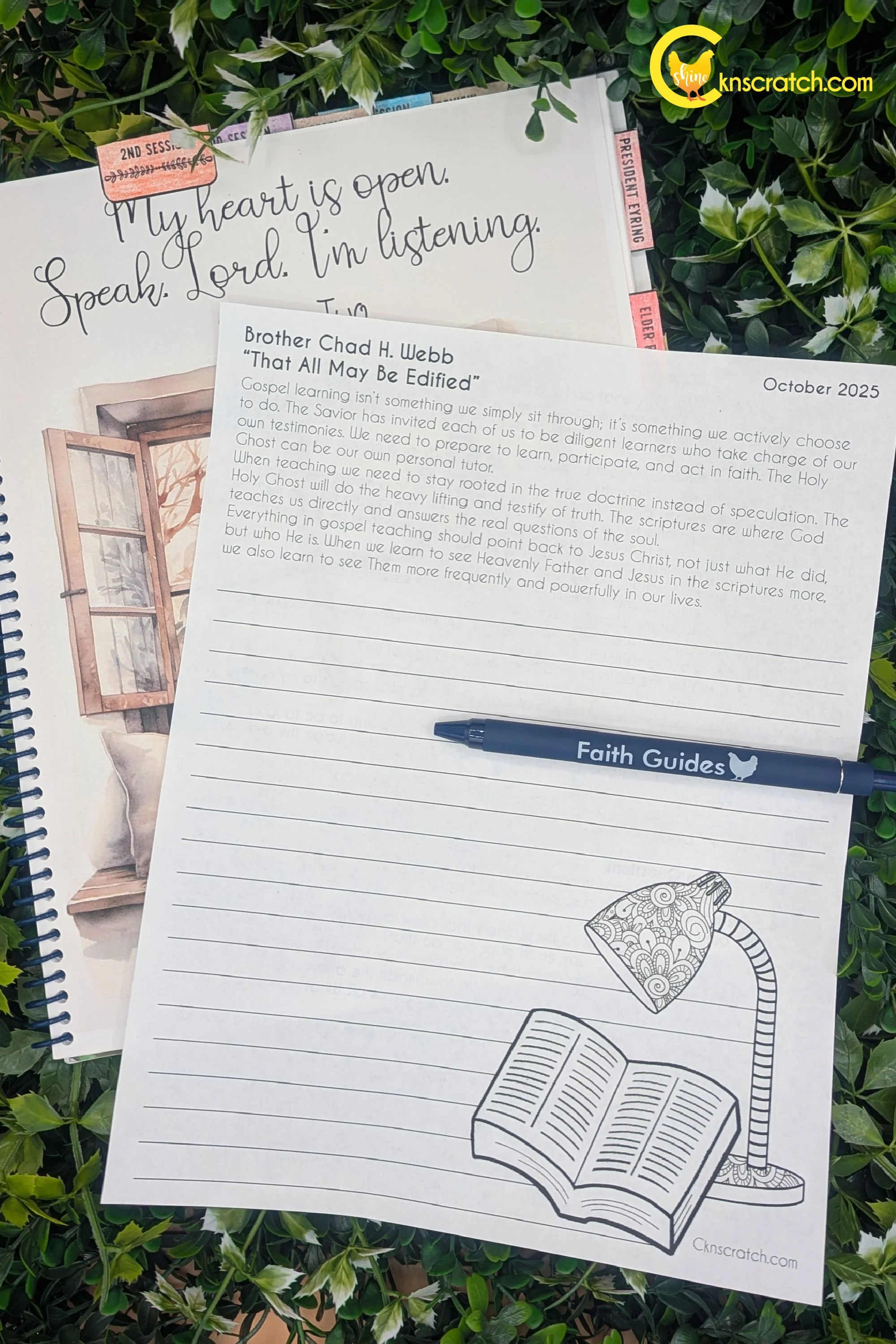
As the new year rolls out, it’s a great time to refocus our efforts in teaching at home and a church. Brother Chad H. Webb’s October 2025 General Conference talk, “That All May Be Edified” is a great one to study and inspire needed adjustments to our teaching. Use our pondering questions to make your own goals, encourage some family learning, and get some inspiration for your next church lesson. You’ll also find a study sheet that includes a short summary, room to record your own revelation, and a little something to color as you ponder and listen.
Save it for later, pin it now
Summary and Personal Ponderings
The three main principles Brother Webb focused on come from the Church manual Teaching in the Savior’s Way: Invite diligent learning, teach true doctrine, and focus on Jesus Christ. Here’s some additional bullet points from his talk though that you may want to take note of:
The Holy Ghost is a divine tutor who knows all things, testifies of truth, and can bring things to our remembrance as we learn and teach.
We invite His influence through faith, worthiness, and deliberate efforts to increase our capacity to receive revelation.
Gospel teaching works best when learners come prepared and actively participate.
Teachers can create experiences that foster personal revelation, then give opportunities for learners to share and edify each other.
Diligent learning includes acting on gospel principles; as we apply them, the Spirit confirms truth again.
To invite the Spirit, we should teach true doctrine rooted in scriptures and modern prophets, avoiding speculation or sensational topics.
Scripture study should include understanding the narrative, identifying principles, and applying them to real life.
A teacher’s love for the scriptures can spark conversion and inspire lifelong devotion to studying God’s word.
Teaching and learning should always focus on Jesus Christ, speaking of Him often and rbearing testimony of Him.
Seeing our lives through the lens of God’s plan (instead of judging the plan by our circumstances) helps us access Christ’s grace, keep covenants joyfully, and grow into His likeness.
Ready to dive in? Be sure to print out the study sheets available toward the bottom of this post. It’s a great place to record your answers to some of these pondering questions. Plus you can print these questions out.
When I think about revelation, what do I expect it to feel like? Is this expectation helping or limiting me? What might be some others ways I can receive revelation?
Do I approach gospel study as a listener or as an active learner? What’s one shift I could make?
What usually blocks my ability to feel the Spirit during study? Am I distracted by speed, distraction, stress, cynicism, something else?
When has the Holy Ghost brought things to my remembrance in a meaningful way?
What am I actively striving to do to ensure the Holy Ghost can always be with me?
How often do I rely on a teacher’s preparation instead of preparing my own heart and mind? Is there anything I can do to prepare myself better?
What is one spiritual habit I want to build to help me be a lifelong disciple?
Where am I tempted to chase interesting topics instead of essential doctrine?
What doctrines anchor me when life feels uncertain?
In my scripture study, do I search for the narrative, the principles, and the application or am I mostly just reading to finish?
How am I feasting on the word of God in my current stage of life?
What things can I do while I study to more deliberately look for Jesus Christ?
Which of Christ’s titles (Redeemer, Lamb of God, Physician, etc.) speaks to my current needs?
When I feel spiritually stuck, what can I do to show I am still willing to be taught?
Do I see my circumstances through the lens of God’s plan or do I judge the plan by my circumstances?
What’s one recent prompting I’ve received, and how did I respond?
What has the Spirit tried to teach me this week?
Discuss it with your family
Brother Webb’s talk is an excellent one to talk about with your family as it can help shape your future Come Follow Me lessons at home. What do you actually all want them to look like? What responsibilities are people willing to accept? Here are a few questions to get you going.
Sometimes family study turns into one person talking and everyone else blinking. What would make it feel more like a discussion than a lecture? How can we invite diligent learning in our family?
Brother Webb encourages us to be learners that come prepared to our church classes too. What’s a realistic way each of us can do that?
Think about the best class you’ve ever been in (church or school). What made it work? What did the teacher do and what did you do that made the difference?
Sometimes we rush through study like it’s a chore to check off. What would help us slow down and really listen to learn?
Brother Webb emphasizes sharing what we’re learning. What’s a low-pressure way we could do that as a family?
When someone asks a question or shares as story in class, it can leave them feeling vulnerable. What are some ways we can help people feel safe and not judged?
We should also be focusing on Jesus Christ more often. What does that look like in our home?
Sometimes we read a scripture story and only talk about the hero. How can we remind ourselves to look for what it teaches about Jesus Christ too?
Brother Webb suggests we can ask, “Can you think of a time when Jesus Christ exemplified this principle?” as we teach and study the scriptures. Want to try it? What principle did we see today in scripture study, and how did Christ live it?
Brother Webb encourages us to see life through God’s plan instead of through the moment. What’s a “moment problem” that feels huge right now, and how might an eternal view change it?
When we’re tired, we default to habits. What habit at home helps invite the Spirit, even on messy days?
If you could improve one thing about our family learning time, would you pick shorter, more consistent, more interactive, or more meaningful? What does that look like to you?
P.S. See if your family can guess the talk first by showing them this short reel that references the story at the beginning of Brother Webb’s talk.

Teach it at church
Are you teaching this lesson in Relief Society, Elders Quorum, or a youth class? Here are a few questions to help you out. These are great especially for the beginning of the year (or any time you need a fresh start) as they can help shape your future classes as you all discuss what you really want out of class and what you are willing to put in. Remember, you can print these questions with our study sheet above.
Brother Webb encouraged us to invite diligent learning as we teach- at home and at church. How have you seen this executed well? What kinds of teacher habits invite participation and what kinds accidentally shut it down (even when the teacher means well)?
Think of a time a lesson felt alive spiritually. What was different about the room, the teacher, or the learners? What could we repeat on purpose?
How have you been able to shift your focus on Jesus Christ as you study the scriptures even when a passage doesn’t mention Him directly? What’s one scripture story you’ve read a hundred times that changed when you started looking for Jesus Christ in it? What did you notice that you hadn’t noticed before?
What does feasting on the word of God look like for your busy life?
When have you felt the Holy Ghost teach you something you didn’t get from the teacher just from the Spirit? What made space for that to happen?
What’s the difference between a class that feels “informative” and one that feels “transformative”?
What do you personally do to come prepared that actually works in real life? What have you tried that didn’t work?
Which is harder for you: asking questions in class, sharing a thought, or sitting in silence long enough to listen? Why? How can your participation (sharing, asking, applying) invite the Spirit? What are ways we might do the opposite?
If someone shares something questionable in class, what’s a kind way to redirect without embarrassing them?
What helps you feel safe enough to share real struggles or real questions at church? What makes you clam up?
When you study the scriptures, what helps you move from “interesting” to “applicable”?
How do we focus on Jesus Christ in lessons without it turning into the same three sentences every week? What fresh approaches have you loved?
Which of Christ’s titles or roles feels most personal to you right now (Redeemer, Physician, Lamb of God, Advocate, etc.)? Why?
Brother Webb suggests seeing life through God’s plan instead of judging the plan by our circumstances. Where is that hardest to do right now (in grief, parenting, health, finances, loneliness, uncertainty)? What helps when that feels impossible?
What’s one small change teachers could make that would help learners take more ownership? What’s one small change learners could make?
If we could pick one goal for our class culture for the next month, what would it be? Examples: “more listening,” “more scripture-first answers,” “more application,” “more kindness to questions,” “more testimony.”
Discover more free printable study sheets for General Conference talks.




Free ideas to help you reach out and minister this December